

Research library
Evidence for the work behind the executive.
Original, cited research on executive time, distributed operations, access governance, and sustainable work design for leadership support teams. Every review separates evidence, operational interpretation, recommended tests, measures, and limitations so readers can inspect how a conclusion was formed.

How the library is prepared
Traceable sources, stated limits, no invented precision.
Each review uses government, academic, standards, or first-party sources. The library avoids combining incompatible studies into new statistics, and every article carries its publication and review dates.
This is general operational information, not legal, medical, employment, privacy, or security advice. Consequential decisions belong with qualified owners.
Read the method before the number. A useful finding is one you can apply, test, and revise.
21 reviews
Hiring Cost Data
What hiring, salary, and workload evidence can and cannot tell you about building executive support capacity.

Executive Assistant Worker Classification: Federal Evidence and Boundaries
A source-led review of federal employee and contractor tests for executive support engagements, with evidence fields and rule-change limits.

Remote Executive Assistant Form I-9 Verification: Evidence for Employers
A federal source review of timing, document choice, representatives, remote examination, retention, and privacy for remote executive assistant hires.

Executive Assistant Overtime Classification: Evidence and Limits
A federal source review of duties, salary basis, hours records, and review boundaries for executive assistant overtime classification.

Executive Assistant Background Checks: Evidence for Fair, Private Hiring
A federal source review of job relevance, disclosure, authorization, adverse action, consistency, and disposal in executive assistant screening.

Structured Interviews for Executive Assistants: What the Evidence Supports
An evidence-led guide to making executive assistant interviews more consistent and job-related without treating one score as a complete hiring decision.

Task-Based Executive Support Role Design: Evidence Beyond Job Titles
A data-led method for defining executive support around actual tasks, dependencies, and competencies instead of relying on an inherited title.

Executive Assistant Employment by Industry in 2025: Interpreting Concentration
A data-led guide to using occupational and industry estimates when planning executive support recruiting, benchmarking, and succession coverage.

Executive Assistant Experience and Training Requirements in 2025
A careful reading of federal job-requirement data for executive assistants, with limits for hiring and onboarding decisions.
Executive Assistant Software Skills in 2025 Job Postings
A source-led analysis of software named in 2025 executive assistant job postings, with clear limits for hiring and training decisions.
Executive Assistant Employment by Industry and Geography in 2025
A careful reading of May 2025 federal employment tables for executive assistants, with guidance on location and industry comparisons.
Executive Assistant Reference Evidence Consistency: A Bounded Study
Executive Assistant Reference Evidence Consistency: A Bounded Study uses reputable public evidence and a bounded local design.
Executive Assistant Work-Sample Validity: Evidence and Limits
Executive Assistant Work-Sample Validity: Evidence and Limits examines how hiring teams can evaluate whether an executive-assistant work sample reflects job-relevant capability using reputable public evidence, explicit measurement boundaries, and a bounded local-study design.
Executive Assistant Onboarding and Knowledge Transfer Evidence
A public-data and work-design analysis of role scope, supervised practice, access readiness, and evidence of onboarding progress.
Executive Assistant Role Requirements: What Public Data Can Support
A public-data review of occupational scope, experience, people skills, telework availability, and the limits of national role classifications.
Executive Support Workforce Outlook: How to Read the Evidence
An evidence-led interpretation of occupational projections, role change, replacement demand, and the limits of national workforce forecasts.

Executive Assistant Workforce Demographics Statistics for 2025
Current U.S. executive assistant workforce statistics on employment, age, sex, race, ethnicity, unemployment, and weekly earnings from BLS.

Executive Assistant Job Outlook Statistics for 2026
Current executive assistant employment, wage, outlook, experience, training, and telework statistics from BLS and O*NET.

Executive Assistant Onboarding Time: Productivity Benchmarks That Hold Up
Measure executive assistant onboarding time with role-specific milestones and research on task mastery, role clarity, and social acceptance.
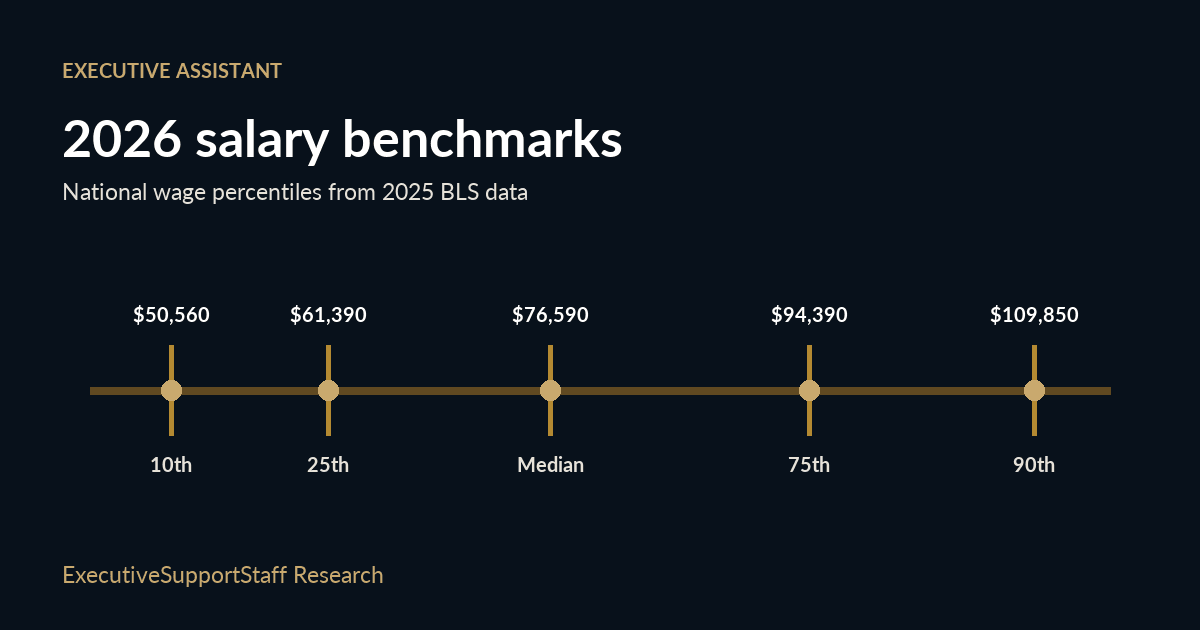
Executive Assistant Salary Benchmarks for 2026
Compare current U.S. executive assistant wage percentiles with projected 2026 starting salaries, then adjust a hiring range for role scope and location.
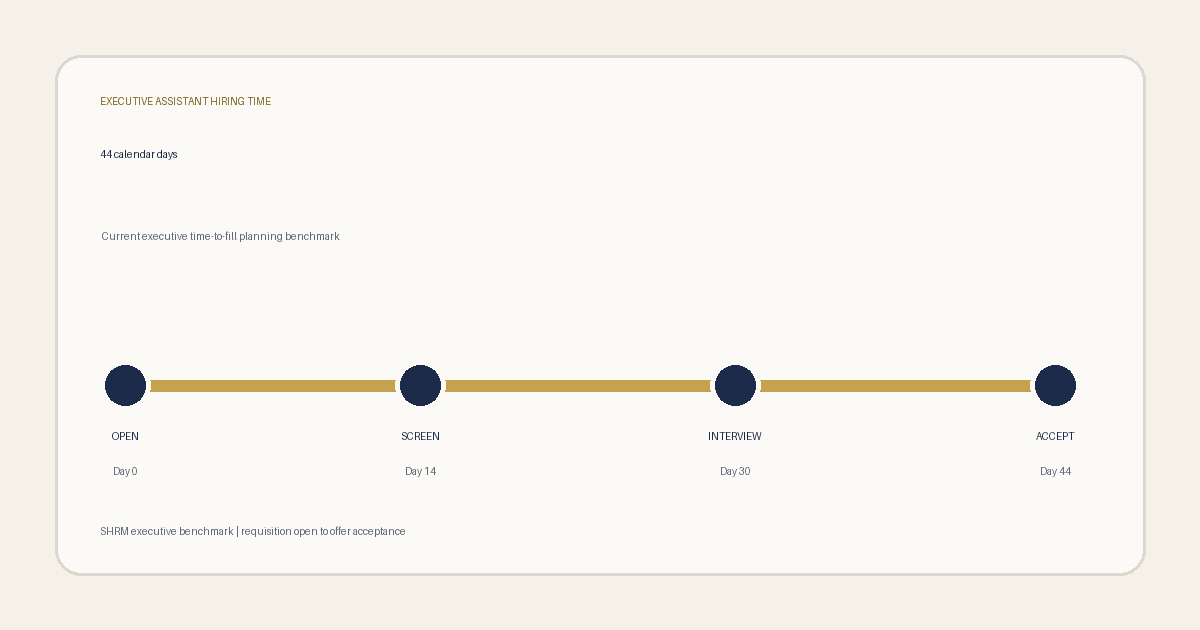
Executive Assistant Hiring Time: Current Recruiting Benchmarks
Plan an executive assistant search with current time-to-fill benchmarks, clear metric definitions, and a stage-by-stage schedule grounded in recruiting data.

Executive Support Staffing Ratios for Growing Companies
Current executive assistant staffing ratio evidence, its limits, and a practical capacity test for growing companies.
27 reviews
Executive Time and Decision Systems
How executive attention is spent, fragmented, protected, and recovered across a working week.
Calendar Conflict Rate and Ownership Evidence
A protocol for measuring conflict frequency, resolution time, and the owner of each decision.
Executive Calendar Hold Expiration Measurement
A reproducible protocol for whether tentative holds expire or convert under declared rules and leave reconstructable evidence, including evidence lineage, reviewer agreement, sensitivity analysis, and responsible limits.
Leadership Approval Queue Cycle-Time Analysis
A reproducible evidence review of where elapsed time accumulates between approval intake and an authorized disposition, including sampling, reliability controls, limitations, and responsible use.
Cross-Executive Scheduling Conflict Audit
A reproducible evidence review of whether scheduling conflicts are classified consistently and resolved with traceable authority, including sampling, reliability controls, limitations, and responsible use.

Executive Briefing Source Traceability: Evidence for Decision-Ready Work
An evidence-led method for connecting briefing claims to current sources, visible uncertainty, and a clear decision request.

Executive Support Exception Reporting: Evidence for Useful Escalation
An evidence-based framework for reporting executive-office exceptions with enough context for action and without turning every variance into noise.

Executive Meeting Decision Records: Evidence for Quality and Accountability
An evidence-based framework for recording decisions, sources, owners, and follow-through without turning every leadership conversation into an indiscriminate transcript.
Leadership Meeting Decision Traceability: Evidence and Measurement
Leadership Meeting Decision Traceability: Evidence and Measurement uses reputable public evidence and a bounded local design.
Multi-Executive Priority Conflicts: Evidence and Measurement
Multi-Executive Priority Conflicts: Evidence and Measurement uses reputable public evidence and a bounded local design.
Executive Calendar Change Volatility: Evidence and Measurement
Executive Calendar Change Volatility: Evidence and Measurement examines how executive teams can measure calendar instability without treating every change as failure using reputable public evidence, explicit measurement boundaries, and a bounded local-study design.
Executive Decision Follow-Through Latency: An Evidence Review
Executive Decision Follow-Through Latency: An Evidence Review examines which records can show whether executive decisions become owned action using reputable public evidence, explicit measurement boundaries, and a bounded local-study design.
Executive Support Interruption Routing: Evidence and Limits
Executive Support Interruption Routing: Evidence and Limits examines how support teams can distinguish necessary escalation from avoidable interruption using reputable public evidence, explicit measurement boundaries, and a bounded local-study design.
Executive Briefing Information Quality: An Evidence Review
A research review of source traceability, decision relevance, uncertainty, and useful measures for executive briefing quality.
Executive Meeting Preparation Demand: Evidence and Measurement
An evidence-led analysis of preparation demand, attendee time, agenda design, and the limits of meeting-count metrics.
Executive Inbox Delegation Accuracy: A Research Framework
A research framework for evaluating delegated inbox decisions through authority, error classes, reversals, and response outcomes.
Executive Calendar Fragmentation: Evidence, Measures, and Limits
A cautious evidence review of task switching, attention residue, meeting distribution, and valid ways to study fragmented executive calendars.
Executive Decision Latency: An Evidence-Led Measurement Review
A research review of how to define decision latency, separate waiting from deliberation, and interpret response-time evidence without inventing targets.

Executive Meeting Cost Calculator and Benchmarks for 2026
Calculate the direct compensation cost of executive meetings using current employer-cost benchmarks, then add preparation and follow-through without overstating productivity loss.

Executive Administrative Workload Statistics: What Current Data Shows
Current statistics on executive time, administrative workload, meetings, and work hours, with clear limits on what each dataset can prove.

Executive Email Statistics: Workload and Response-Time Benchmarks
Executive email statistics on workload, deferral, revisits, and response behavior, with source methods and practical inbox measures.

AI Administrative Work Time Savings: What the Evidence Shows
Measured AI time savings in email, documents, writing, and customer support, with study designs and limits made clear.

Executive Business Travel Statistics and Workload Evidence
Current business travel volume, spending, trip pattern, and disruption statistics, with practical limits for estimating executive travel workload.
Measuring Administrative Support Capacity Safely
A practical framework for measuring executive support demand using workload, complexity, coverage, and service reliability instead of crude task counts.
Delegation and Decision Rights in Executive Support
A research synthesis on translating administrative duties into clear decision rights, escalation rules, and reviewable delegation agreements.
Calendar Fragmentation and Executive Focus Time
A source led review of task switching, attention residue, and calendar fragmentation with cautious practices for protecting complex executive work.
Meeting Load Governance for Executive Teams
Evidence based guidance for reviewing meeting purpose, attendance, preparation, and decision outputs without treating every meeting minute as waste.
How to Audit Executive Time for Better Decisions
A practical research synthesis for classifying executive time, testing calendar alignment, and turning a four week audit into defensible operating changes.
30 reviews
Distributed Executive Operations
Operating practices for support teams that work across locations, time zones, and communication channels.
Board Packet Completeness and Decision Support
A protocol for reviewing agenda links, materials, approvals, and open questions.
Travel Disruption Response and Communication Evidence
A protocol for reviewing disruption detection, options, approvals, and communication records.
Cross-Role Briefing Handoff Reconstruction Study
A reproducible protocol for whether another authorized support professional can reconstruct and continue an executive briefing handoff, including evidence lineage, reviewer agreement, sensitivity analysis, and responsible limits.
Executive Briefing Source Traceability Study
A reproducible evidence review of whether claims in executive briefings can be traced to current, authoritative source evidence, including sampling, reliability controls, limitations, and responsible use.
Executive Commitment Reopen Rate Study
A reproducible evidence review of how often closed executive commitments return and which evidence-supported reasons explain reopening, including sampling, reliability controls, limitations, and responsible use.

Executive Business Travel Health Planning: Evidence for Support Teams
A source-led method for preparing itinerary facts, qualified health review, insurance contacts, and privacy boundaries for international executive travel.

Daylight Saving Scheduling for Executive Teams: What the Evidence Supports
A source-led review of time-zone data, daylight-saving transitions, and scheduling controls for executive calendars.

Executive Emergency Contact Directories: Evidence for Reliable Reachability
A continuity-led method for maintaining verified contacts, alternate channels, access boundaries, and realistic communication tests.

Time-Zone Handoffs in Executive Support: Evidence for Reliable Coverage
A research synthesis for designing cross-time-zone handoffs around accepted ownership, secure access, and humane coverage boundaries.

Executive Support Continuity Exercises: Evidence for Testing Coverage
A standards-based analysis of how executive offices can test backup coverage and recovery assumptions without staging unsafe disruptions.

Executive Assistant Telework Task Fit: What 2025 Evidence Supports
An evidence-led test for deciding which executive support duties fit remote, hybrid, or in-person delivery without turning a national estimate into a universal rule.
Accessible Executive Meetings: Standards and Operating Evidence
A standards-led review of accessible remote and hybrid meetings, from platform selection and materials to captions and participation paths.
Executive Travel Disruption Recovery: A Records Analysis
Executive Travel Disruption Recovery: A Records Analysis uses reputable public evidence and a bounded local design.
Remote Backup Authentication Readiness: Evidence Review
Remote Backup Authentication Readiness: Evidence Review uses reputable public evidence and a bounded local design.
Delegated Instruction Revision Recurrence: An Evidence Synthesis
Delegated Instruction Revision Recurrence: An Evidence Synthesis uses reputable public evidence and a bounded local design.
Distributed Executive Handoff Acceptance: A Research Framework
Distributed Executive Handoff Acceptance: A Research Framework examines what evidence shows that a distributed executive-support handoff was actually received and understood using reputable public evidence, explicit measurement boundaries, and a bounded local-study design.
Executive Time-Zone Meeting Burden: Evidence and Measurement
Executive Time-Zone Meeting Burden: Evidence and Measurement examines how distributed leadership teams can assess uneven meeting-time burden using reputable public evidence, explicit measurement boundaries, and a bounded local-study design.
Executive Support Backup Readiness: An Evidence Synthesis
Executive Support Backup Readiness: An Evidence Synthesis examines which observable tests distinguish named backup coverage from usable continuity using reputable public evidence, explicit measurement boundaries, and a bounded local-study design.
Executive Travel Disruption Resilience: An Evidence Synthesis
A source-led synthesis of remote access, continuity, handoffs, and recovery evidence for disrupted executive travel.
Single-Point Dependency in Executive Support: Evidence and Limits
A research analysis of backup readiness, concentrated knowledge, access recovery, and continuity evidence in executive support.
Distributed Briefing Version Control: Evidence and Governance
An evidence-led review of briefing provenance, access, version identity, handoffs, and recovery in distributed executive support.
Distributed Executive Support Continuity: A Research Synthesis
A research synthesis on continuity, handoff acceptance, secure remote access, time-zone coverage, and service recovery in distributed support teams.
Hybrid Executive Support Coverage: Evidence Across Work Locations
An evidence-led analysis of hybrid coverage, collaboration, location-dependent duties, secure access, and valid service measures.

Remote Executive Communication Statistics and Benchmarks
Current remote executive communication statistics and practical measures for response time, decisions, handoffs, and meeting burden.

Remote Executive Assistant Adoption Statistics
Current remote executive assistant statistics, national remote-work baselines, and limits on what adoption data can prove.
Operating Models for Remote Executive Support
A research synthesis for defining remote executive support coverage, communication, access, backup, quality review, and escalation responsibilities.
Reliable Handoffs in Distributed Executive Support
A practical synthesis for designing handoffs across time zones with clear state, ownership, secure context, acceptance, and escalation rules.
Remote Meeting Protocols for Executive Decisions
Research informed protocols for secure remote executive meetings, including preparation, attendance, decision records, and follow up ownership.
Asynchronous Briefing Systems for Executives
A source based design for concise executive briefs with ownership, evidence links, decision requests, access controls, and reliable update timing.
Communication Cadence for Hybrid Executive Teams
A research synthesis for choosing synchronous and asynchronous executive communication based on decision need, context, security, and time zones.
31 reviews
Security and Access Governance
Access, confidentiality, records, and decision controls for assistants working close to sensitive information.
Inbox Delegation Access and Revocation Review
A protocol for reviewing delegated access, authority, and removal evidence.
Reliability of Executive Inbox Delegation Records
A reproducible protocol for whether inbox delegation records identify current access, authority, and revocation state consistently, including evidence lineage, reviewer agreement, sensitivity analysis, and responsible limits.
Leadership Offsite Document Custody Completeness
A reproducible protocol for whether sensitive offsite materials can be traced across creation, distribution, retrieval, and disposal, including evidence lineage, reviewer agreement, sensitivity analysis, and responsible limits.
Executive Signature Request Verification Consistency
A reproducible protocol for whether independent reviewers apply the same authority and evidence rules to executive signature requests, including evidence lineage, reviewer agreement, sensitivity analysis, and responsible limits.
Backup Coverage Readiness Reliability Review
A reproducible evidence review of whether backup coverage records predict an authorized assistant can perform critical work without unsafe access, including sampling, reliability controls, limitations, and responsible use.

Executive Suite Visitor Access Records: Security and Privacy Evidence
A standards-led review of visitor authorization, badges, escorts, access records, privacy minimization, and exception review for executive suites.

Executive Support Vendor Access Onboarding: Federal Security Evidence
A federal source synthesis for scoping third-party access to executive systems, assigning identities, recording duties, and preparing revocation.

Vendor Offboarding in Executive Support: Evidence for Closing Access
A controls-based review of removing vendor accounts, delegated access, devices, tokens, shared records, and recovery paths.

Executive Meeting Recording Governance: Evidence Before Pressing Record
A privacy and records review of when executive meetings are recorded, who is informed, where files go, and when they are deleted.

Executive Calendar Metadata Privacy: What the Evidence Supports
A privacy-led analysis of how executive offices can preserve useful scheduling context while reducing unnecessary exposure in calendar records.

Executive Approval Request Verification: Evidence Beyond an Email Reply
A controls-based analysis of how executive support teams can verify consequential approval requests without assuming every familiar message is authentic.

Executive Office Record Lifecycles: Evidence for Retention and Access Boundaries
A records-and-security analysis of why executive-office information needs explicit ownership, retention, access, and disposition decisions.

Phishing-Resistant Authentication for Executive Offices: Evidence and Limits
A standards-based analysis of why executive support accounts need stronger authentication and how to stage adoption without confusing MFA with complete protection.

Business Email Compromise Controls for Executive Offices
An evidence-led review of impersonation, payment-change risk, independent verification, and incident response in executive support work.

Executive Expense Documentation and Accountable Plan Evidence
A source-led review of business connection, substantiation, excess returns, and internal control for executive expenses.

Executive Electronic Message Recordkeeping Evidence
A records-led review of executive email, chat, personal accounts, retention, capture, privacy, and role-based governance.
Generative AI Governance for Executive Support Work
A standards-led review of how executive support teams can govern generative AI inputs, outputs, access, review, and vendor claims.
Board Material Distribution Lead Time: An Evidence Review
Board Material Distribution Lead Time: An Evidence Review uses reputable public evidence and a bounded local design.
Executive Inbox Sensitivity Classification: Evidence and Limits
Executive Inbox Sensitivity Classification: Evidence and Limits uses reputable public evidence and a bounded local design.
Executive Vendor Privileged Access Review: Evidence and Governance
Executive Vendor Privileged Access Review: Evidence and Governance uses reputable public evidence and a bounded local design.
Executive Board Material Provenance: Evidence and Governance
Executive Board Material Provenance: Evidence and Governance examines how executive support teams can assess the provenance and approved state of board materials using reputable public evidence, explicit measurement boundaries, and a bounded local-study design.
Executive Confidentiality Escalation Readiness: Evidence Review
Executive Confidentiality Escalation Readiness: Evidence Review examines what operational evidence shows that support staff can escalate suspected information exposure safely using reputable public evidence, explicit measurement boundaries, and a bounded local-study design.
Executive Support Access Reviews: Coverage and Control Evidence
A standards-based analysis of permission reviews that preserve executive support coverage while reducing unnecessary access.
Executive Stakeholder Data Minimization: An Evidence Review
A privacy and security review of purpose, collection, access, retention, and operational need in executive stakeholder records.
Delegated Executive Access Controls: Evidence and Governance Boundaries
An evidence-led review of identity, authorization, least privilege, delegation, review, and recovery for executive support access.
Executive Support Log Minimization: Evidence and Privacy Tradeoffs
A standards-based analysis of useful audit events, data minimization, retention, access, and privacy risks in executive support logging.
Incident Readiness for Executive Information
A practical research synthesis for preparing executive support teams to recognize, contain, escalate, document, and recover from information incidents.
Secure Workflows for Executive Business Travel
A standards based synthesis for preparing devices, access, communications, and incident contacts for executive travel without alarmist assumptions.
Audit Logging for Executive Support Workflows
A practical guide to logging sensitive executive support actions without collecting unnecessary message content or creating a new privacy risk.
Safer Alternatives to Shared Executive Credentials
A security standards synthesis on replacing shared passwords with delegation, role accounts, vaulting, strong authentication, and accountable recovery.
Least Privilege for Executive Support Access
A standards based approach to granting assistants only the access needed for current duties while preserving continuity, review, and emergency recovery.
19 reviews
Work Design and Wellbeing
Sustainable work design, coverage, and workload practices for the people supporting leadership.
Executive Support Coverage and Handoff Evidence
A protocol for reviewing coverage, handoff completeness, and unresolved ownership during absences.
Executive Office Emergency Action Plans: Evidence for Support Teams
A source-led framework for emergency reporting, evacuation, accountability, trained roles, exercises, and continuity in an executive office.
Executive Assistant Accommodation Requests: Evidence for a Reliable Process
A federal source review of request recognition, essential functions, the interactive process, confidentiality, implementation, and review.

Executive Support Leave Coverage: FMLA Evidence and Continuity Boundaries
A federal source review for separating protected-leave administration from executive-office coverage, handoff, privacy, and restoration planning.

Accessible Executive Briefing Documents: Standards and Practical Evidence
A standards-led method for producing executive briefs with usable structure, text alternatives, tables, color, and human review.

Executive Support Service Measurement: Evidence Without Surveillance
An evidence-led framework for measuring executive support reliability through service outcomes while limiting unnecessary worker and stakeholder data.

Nonstandard Schedules and Fatigue in Executive Support: What Evidence Shows
A cautious synthesis of occupational schedule data and fatigue research for designing after-hours executive coverage without making individual health claims.

Executive Assistant Workstation Demands and Ergonomic Evidence in 2025
An evidence-led review of sitting, sit-stand choice, computer-workstation design, variation, and the limits of occupation averages.
Executive Assistant Schedule Flexibility Statistics for 2025
Current occupational statistics on varying schedules, telework, breaks, and autonomy, interpreted for sustainable executive support design.
Executive Support After-Hours Recovery: Evidence and Limits
Executive Support After-Hours Recovery: Evidence and Limits uses reputable public evidence and a bounded local design.
Executive Support Workload Recovery Windows: Evidence Review
Executive Support Workload Recovery Windows: Evidence Review examines how teams can examine whether workload returns to a sustainable baseline after peak demand using reputable public evidence, explicit measurement boundaries, and a bounded local-study design.
Executive Support Surge Recovery: Workload Evidence and Limits
A research synthesis on event-driven workload, recovery, control, continuity, and responsible interpretation of support surges.
After-Hours Demand in Executive Support: What the Evidence Shows
A source-led analysis of after-hours demand, recovery opportunity, workload design, and the limits of message-volume data in executive support.
Executive Support Workload Variability: A Research-Based Analysis
A research-based review of workload variability, event surges, recovery, staffing interpretation, and evidence limits in executive support.
Operational Signals of Burnout Risk in Support Work
A nonclinical framework for noticing sustained workload and work design risks, responding early, and directing health concerns to qualified support.
Meeting Practices and Workplace Wellbeing
A source based review of how meeting purpose, timing, inclusion, preparation, and recovery can support both coordination and sustainable work.
Manager Support and Healthy Work Design
A research synthesis for managers of executive support teams covering clarity, autonomy, resources, recognition, participation, and workload review.
Workload and Recovery Boundaries in Support Teams
A research led framework for reviewing working time, recovery opportunity, role clarity, and workload signals without making medical conclusions.
Interruption Load in Executive Operations
A cautious synthesis of task switching and workplace evidence with practical ways to classify interruptions without suppressing necessary escalation.
Need help applying the evidence to your team?
We can translate the research into a practical support scope without turning it into a generic recommendation.