

executive assistant hiring time
Abstract
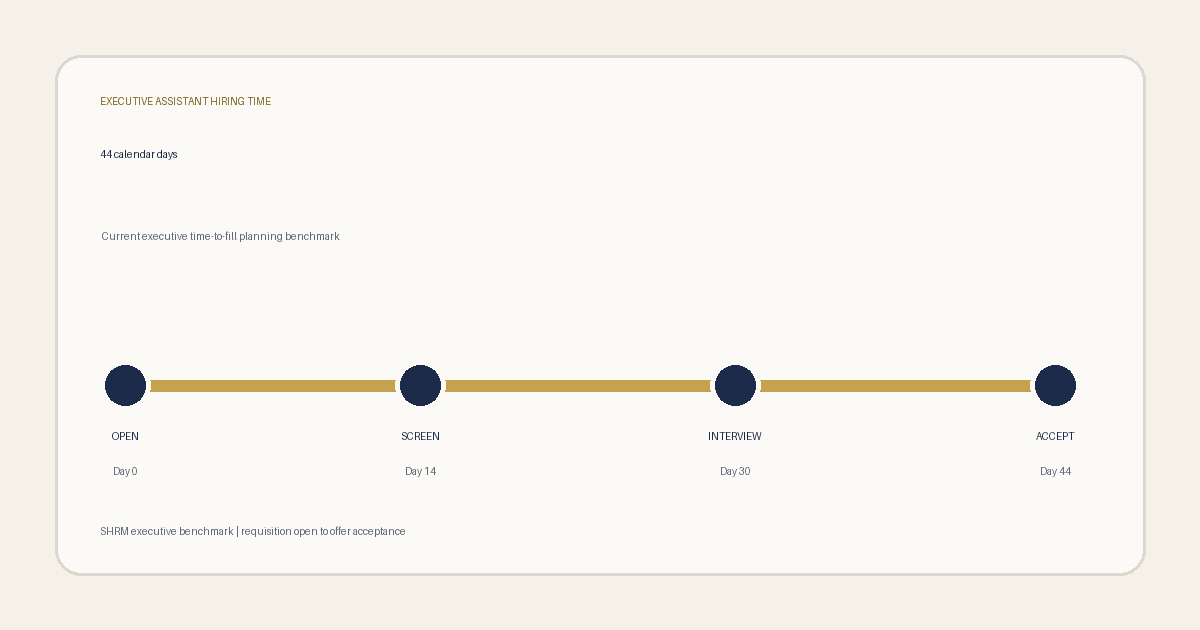
A reasonable planning baseline for an executive assistant search is about 44 calendar days from an opened requisition to an accepted offer. SHRM reported a 44 day median for executive positions in its 2025 benchmarking data, and its 2026 brief says the executive median was unchanged. [1][2] That is a broad executive benchmark, not an executive assistant guarantee. Employers should define the clock, track each recruiting stage, and add onboarding or notice time separately.
Methodology
This review prioritizes sources that disclose survey methods or the recruiting records behind their findings. SHRM fielded its 2025 benchmarking survey electronically from January 9 through March 3, 2025. It received responses from 2,371 active U.S. SHRM members, sampled extra vice presidents and more senior members, did not weight results, and allowed the sample size to vary by metric. [3] The 2026 SHRM brief covers data from more than 4,600 organizations. [1] Ashby analyzed applicant tracking data rather than survey answers, including 54 million applications and 93,000 jobs from January 2021 through March 2026 for its recruiting operations report. [7] BLS JOLTS is administrative labor market context. It measures openings, hires, and separations, not days needed to fill one vacancy. [4][5]
What the evidence can support
SHRM defines time to fill as calendar days from opening the job requisition through candidate acceptance. Its 2025 data brief put the median at 44 days for both executive and nonexecutive positions. The 2026 brief reports that nonexecutive time to fill fell to 39 days while executive time to fill remained at the prior year level. [1][2]
The benchmark supports a six to seven week planning assumption for a conventional executive assistant search. It does not establish an executive assistant specific national median. SHRM groups executive jobs together, and its survey respondents span industries, sectors, regions, and employer sizes. [3] A company should compare its own result with 44 days only after matching SHRM's start and stop points. BLS labor-flow data and Ashby applicant tracking records provide context, but they measure different units. [4][5][6][7]
What 44 days includes and excludes
The SHRM clock starts when the requisition opens, not when a manager first discusses adding support. It stops when the candidate accepts, not on the first day of work. [2] Approval delays before opening the role and a successful candidate's notice period sit outside the measure. Mixing either period into the number makes comparison unreliable.
Record requisition approval, requisition opening, and offer acceptance as separate dates. Keep the employee start date as a fourth field. This separates workforce planning delay from recruiting time and preemployment time without forcing every interval into one metric.
How role type changes the schedule
Ashby's applicant tracking data shows why one companywide target can mislead. For hires made in the second and third quarters of 2025, business roles had a 30 day median time to hire and 75 percent were hired within 46 days. Technical roles had a 40 day median, with 75 percent hired within 57 days. [6] Ashby uses time to hire, so employers should confirm its clock before comparing it with SHRM's requisition-to-acceptance measure.
An executive assistant role may behave like a business role in the market, but executive access, confidentiality, scheduling exercises, and several interviewers can lengthen its evaluation. Those factors are local process choices, not published national premiums. A role supporting one leader with settled requirements will usually be easier to schedule than a search requiring agreement across a leadership team.
A stage-by-stage planning model
Use the 44 day median as a control total, then assign internal service targets to the stages your team controls. A practical plan records days for sourcing and initial review, screening, interviews, references or work samples, offer approval, and candidate decision. The stage targets should sum to the intended recruiting window and identify an owner for every handoff.
Do not turn that model into false precision. SHRM reported that screening and interviewing averaged about eight to nine days each in its 2025 results, but an average for a broad respondent pool is not a deadline for one search. [3] If interview scheduling takes 15 days, record the cause. If sourcing takes longer because the brief changed, restart or annotate the clock instead of hiding the change in a blended total.
How current labor turnover data fits
BLS reported 63.0 million hires during 2025 and an annual average hires rate of 3.3 percent, down from 3.4 percent in 2024. [4] JOLTS produces monthly and annual estimates from establishments and defines a hire as an addition to payroll. [5] These are labor market flow measures. They do not say that an executive assistant vacancy should close faster or slower than 44 days.
JOLTS is useful as context when interpreting a company trend. A slower internal hiring cycle might reflect applicant supply, approval friction, compensation, or role design. The national hires rate cannot identify which cause applies. Diagnose the stages in the company's own recruiting record before changing the benchmark.
How to shorten time without weakening selection
Start with an approved role brief, compensation range, interview panel, and decision owner before the requisition opens. Reserve interview blocks in advance and decide which evidence each interviewer will collect. The guide to hiring an executive assistant covers the broader process. These executive assistant interview questions can help the panel avoid repetitive conversations.
Track waiting time between stages as well as active evaluation time. Ashby's recruiting operations research separates scheduling, scorecard completion, and offer approvals because those handoffs can delay the process. [7] Faster is useful only when the role requirements and evidence standard remain in place. A rushed acceptance followed by a reopened search is not an improvement.
Limits and a decision rule
The central limitation is occupational specificity. No cited source publishes a national executive assistant only time-to-fill estimate with disclosed methods. SHRM provides the closest current executive benchmark, while Ashby offers role-family and process context from applicant tracking records. Survey results and system records answer related but different questions.
Plan around 44 calendar days to offer acceptance, then adjust for demonstrated local constraints. Review progress by stage at least weekly. If the role remains open beyond the plan, identify the stalled handoff before widening requirements or lowering the evidence standard. Organizations that need an alternative to a direct hire can discuss executive support options, but that choice is not part of the recruiting benchmark.
Key findings
- SHRM reported a 44 calendar day median time to fill for executive positions in 2025, measured from requisition opening to offer acceptance. [2]
- SHRM says executive time to fill remained unchanged in 2026, while the nonexecutive median fell to 39 days. [1]
- Ashby reported a 30 day median for business hires and a 40 day median for technical hires in the second and third quarters of 2025. [6]
- BLS JOLTS measures labor market flows, not the duration of an individual recruiting process. [4][5]
- A 44 day baseline is useful for planning, but it is not an executive assistant specific national guarantee.
Sources
- 2026 Recruiting Executives Benchmarking: Attracting Critical Talent, SHRM
- 2025 Recruiting Executives Benchmarking Data Brief, SHRM
- SHRM Releases 2025 Benchmarking Reports, SHRM
- Job Openings and Labor Turnover, January 2026, U.S. Bureau of Labor Statistics
- Job Openings and Labor Turnover Survey Handbook of Methods, U.S. Bureau of Labor Statistics
- Recruiter Productivity, 2026 Talent Trends Report, Ashby
- Recruiting Operations Benchmarks, 2026 Talent Trends Report, Ashby
- Hiring Benchmarks 2026, Greenhouse
- Recruiting Benchmarks 2025, SmartRecruiters
- Talent Experience Insights, iCIMS